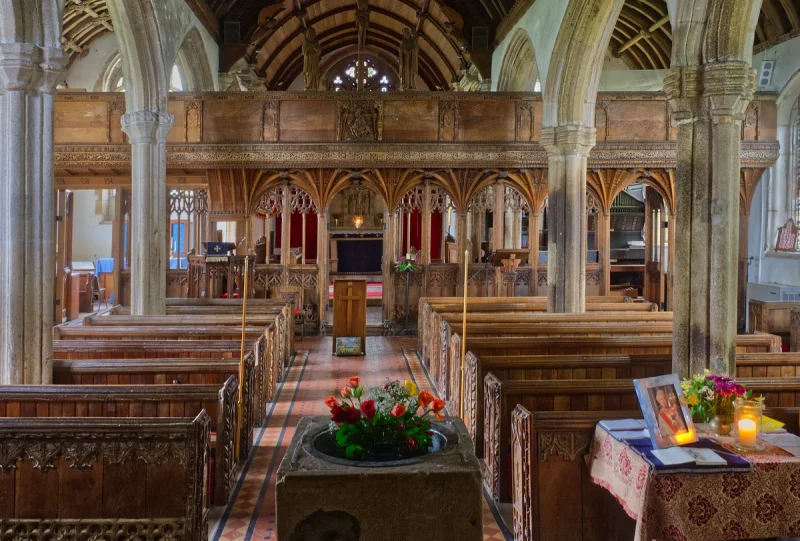
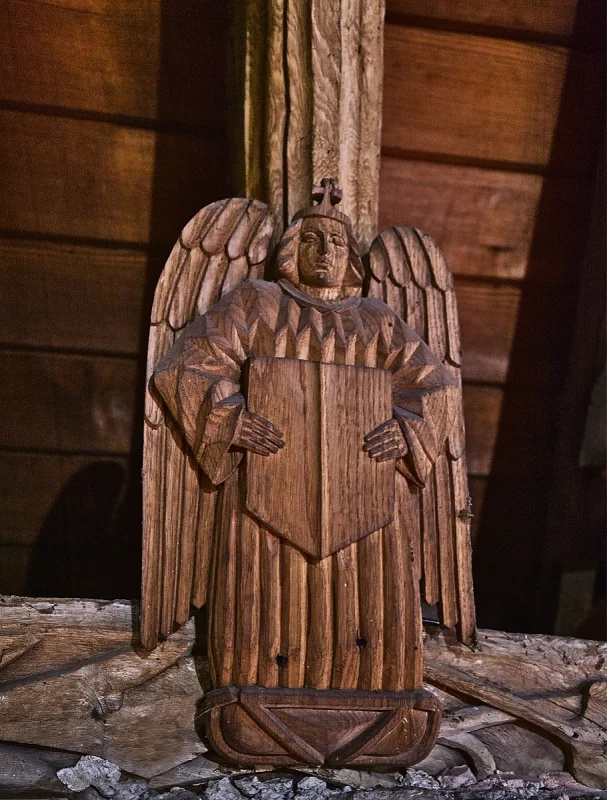
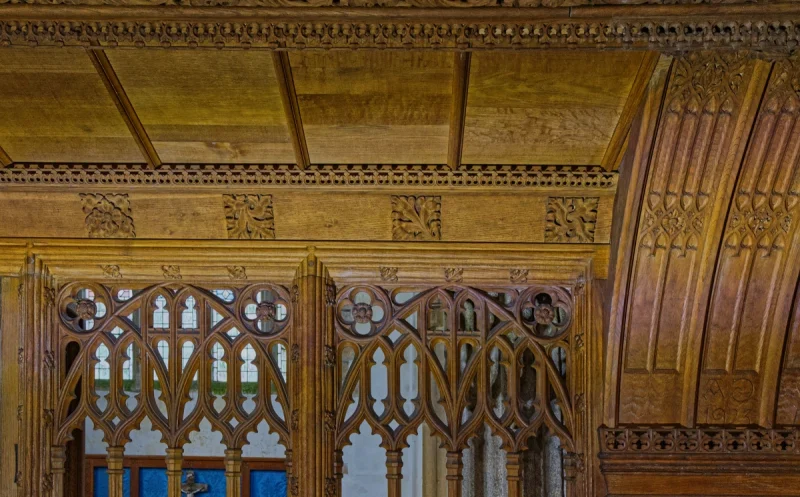
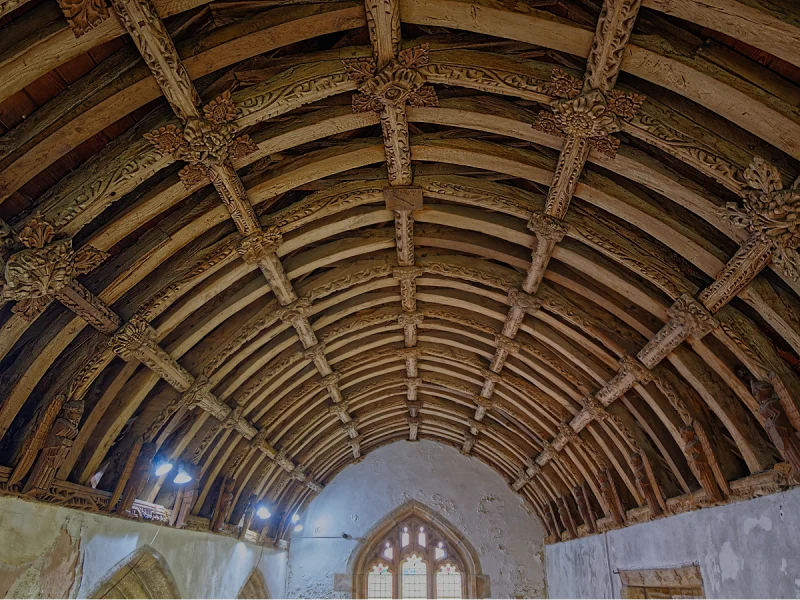
The interior of St Thomas’ church is striking. The first impression is of wood – masses of carved oak, dozens of beautiful bench ends and a high barrel roof with angels. And last – but not least – an intricate and imposing rood screen.
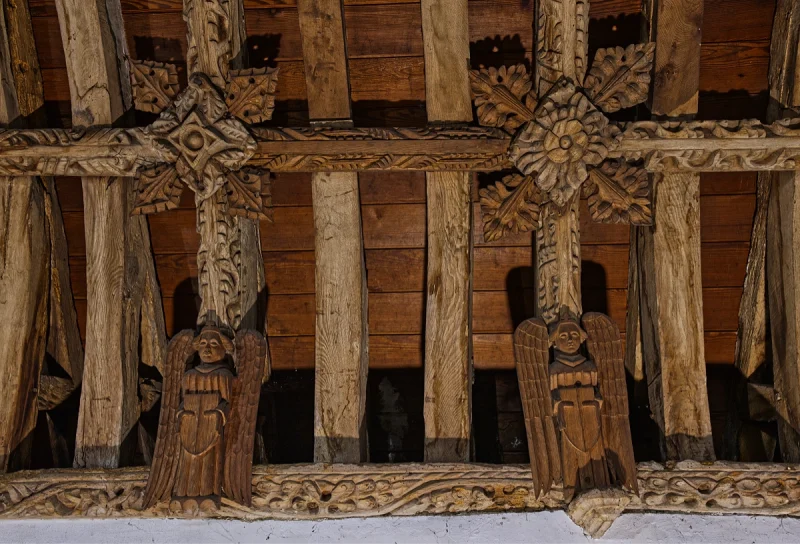
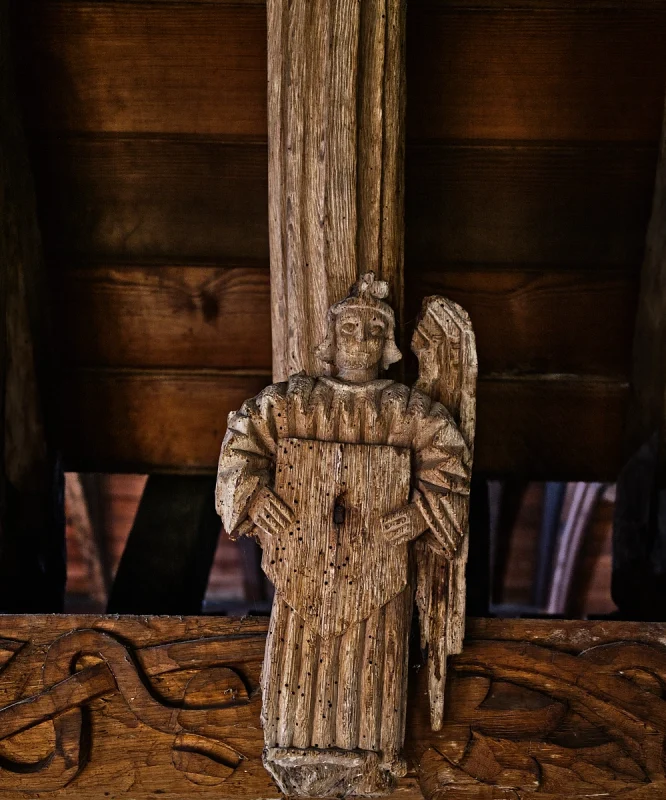
The barrel roof and the carved lintels over the windows are the work of 15/16th century, installed when the church was enlarged, although much of it was then renovated in the 1850s. The roof bosses are decorated with grapes and vines, while rows of angels peer down at the congregation from stone supports along the wall plates. There are twenty-eight in the north aisle alone.
The Nave, Chancel and Altar
The nave is bounded by 15th century granite pillars which interestingly do not match in the north and south aisles, indicating they were probably installed at different times. In the south arcade they are monoliths, made from single pieces of stone and their capitals have elaborate four-roll moulds. The pillars in the north aisle have cup capitals and are each made of more than one piece of stone.
The bench end on the front pew to the south of the nave is carved with a W for William Kelly and was installed in 1537 – presumably this was the Kelly family pew for open services, its closeness to the pulpit indicating the importance of the family as benefactors.
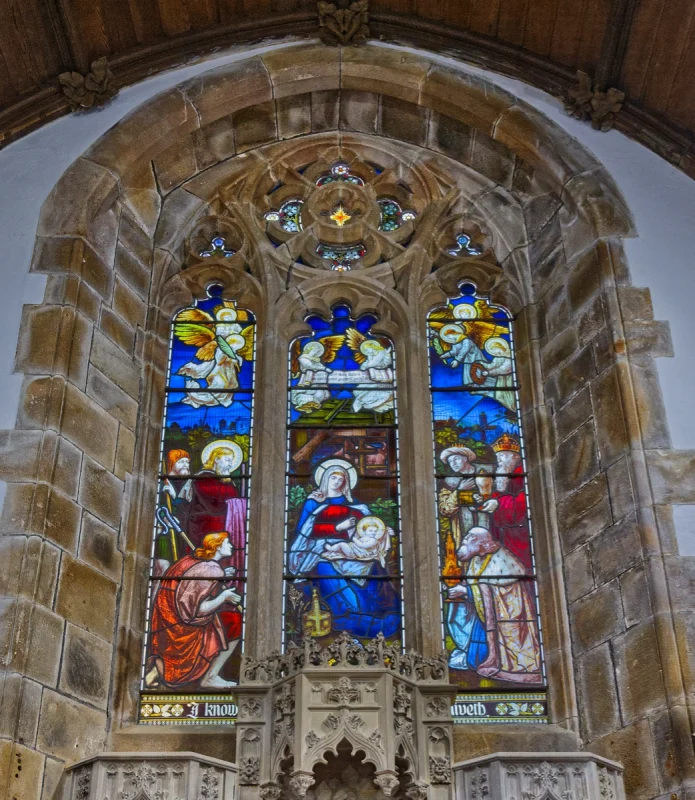
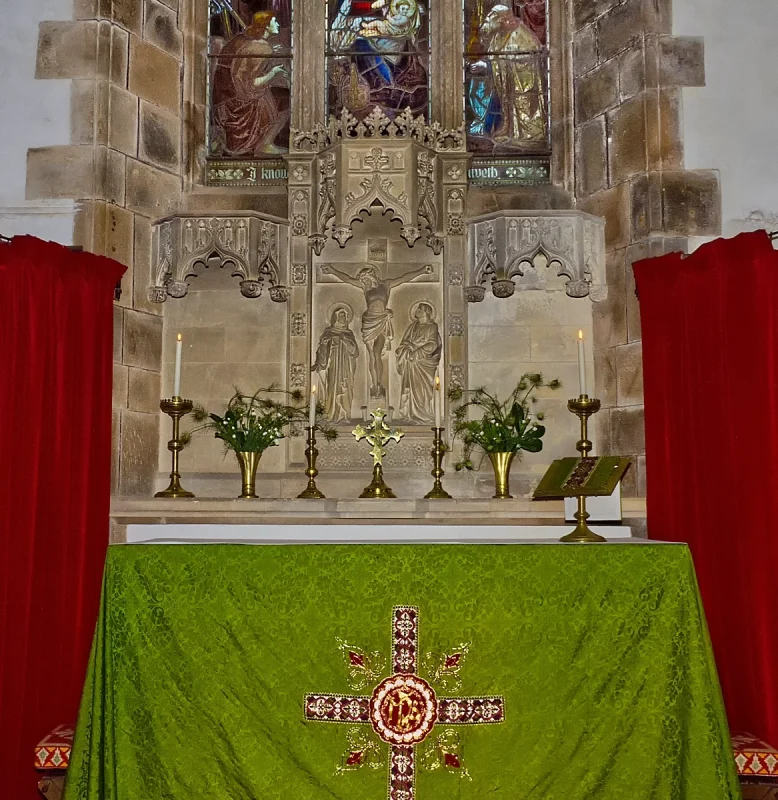
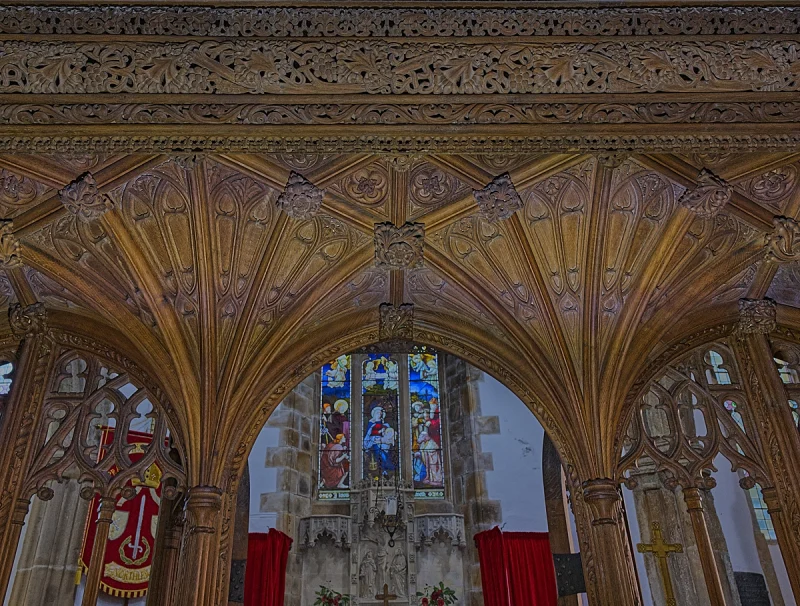
The Epiphany window in the east wall, visible through the central doors of the rood screen, depicts the arrival of the shepherds and wise men to worship the baby Jesus. It was the gift of Jacquetta Harriet Woollcombe and the elaborate stone reredos behind the altar was erected in 1894 in her memory.
The rood screen
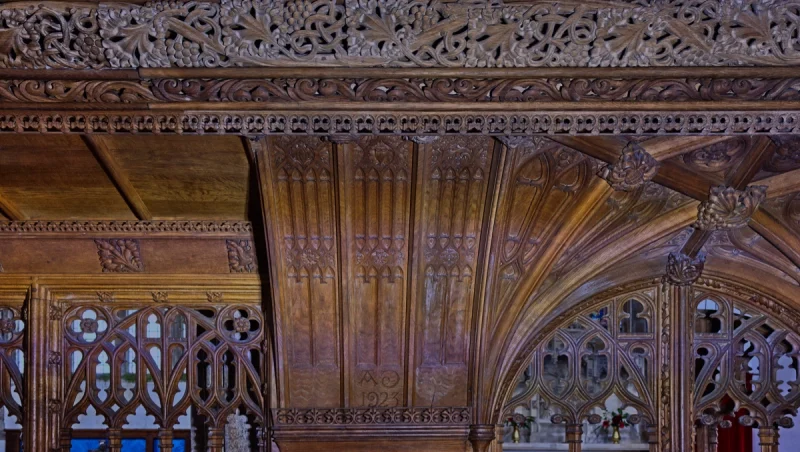
The ancient rood screen, defaced and broken in the time of the Puritans was condemned as unsafe in 1810 and the Rural Dean ordered it to be repaired or removed. The screen was restored by Herbert Read of Exeter after the plans of F C Eden, a London architect. It took most of the 1920s to complete at a total cost – then – of £1,549.
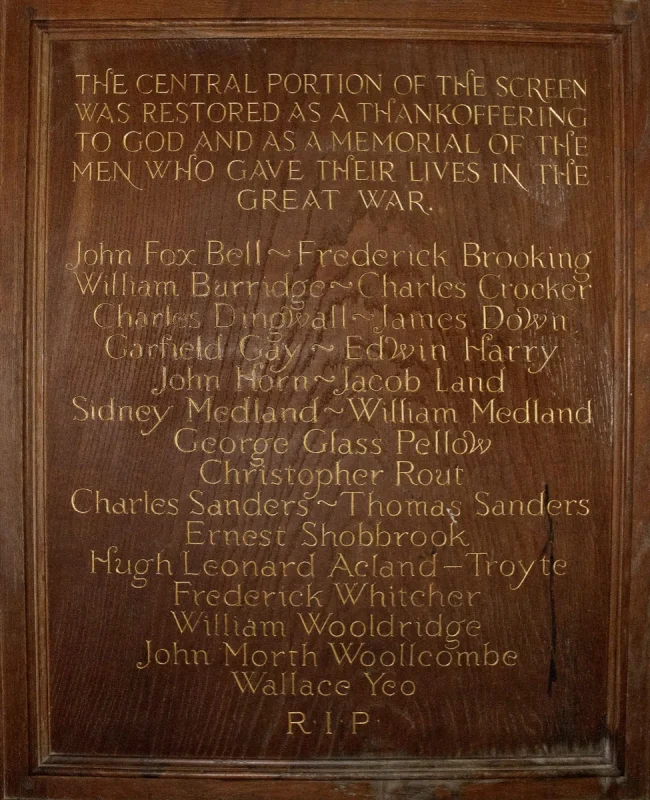
The central portion was the first to be completed, dedicated by Bishop Maude of Kensington in July 1923 as a memorial to those villagers who died in the First World War. The date is carved above the pulpit. The north bay Rutleigh Chapel was dedicated in 1927 in memory of Rectors Herbert and Worthington. The screen here is a different design with square heads. The south bay was completed in 1929, commemorating Herbert and Emily Woollcombe whose family estate was in Ashbury.
Above the central portion is the crucifix and figures of Mary Magdalene and John – and, on the very top of the cross, a traditional pelican brooding over her young, guarded by two angels. The rood loft,or gallery, is reached by the original narrow spiral staircase behind the locked gate. The steps are worn by centuries of worshippers who have climbed the ‘Hill of Calvary’ to be nearer to God.
The Rutleigh Chapel
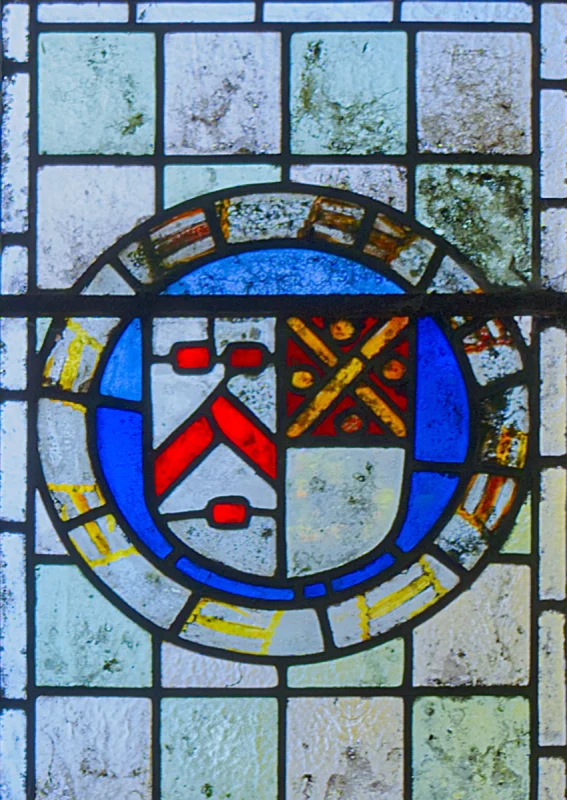
The Chapel at the eastern end of the north aisle was once in the care of William Kelly and his family from Rutleigh Manor who had paid for its construction. Here the family honoured Jesus, his blessed Mother and the Saints. The original altar has now disappeared and the piscina walled up but Kelly is remembered by the two medallions in the window and the WK with the Kelly arms carved at the top of one of the pillars.
The Chapel houses a wooden memorial plaque commemorating the twenty-two parishioners who lost their lives in World War I when Northlew unfortunately lost the greatest proportion of enlisted men in any community in the UK. The altar in the chapel is dedicated to the four who were killed in World War II.
Stained glass windows
Several of the windows are plain originals but there are three memorial windows erected in the late 1800s/early 1900s. The most prominent is the Epiphany window above the altar, depicting the visit of the Magi and shepherds to the manger.
The Pellew stained glass window in the south wall is the work of George Kruger Gray (1880-1943), an English artist also remembered for his designs of coinage. The window was installed in 1927 (MDCCCCXXVII) to commemorate John and Grace Pellew and their sons Henry, John and Albert. The Pellews were an active Northlew farming family.
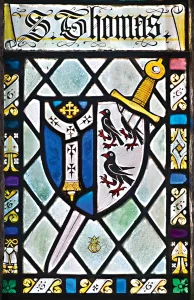
The window has four lights, each featuring a different Saint.On the left St Joseph of Arimathea is carryingthe Holy Grail and his staff, which – it’s said – he planted in the ground at Glastonbury. It took root and grew into the Glastonbury thorn.
St Thomas Archbishop of Canterbury the Martyr is Patron Saint of Northlew and holds the church in his left hand with his Archbishop’s cross. His right hand is raised in benediction and he is wearing the Eucharistic vestments of an Archbishop. In the base are the arms of Becket next to those of the Diocese of Canterbury and gashed with the sword with which he was murdered.
St Brannock Abbot and Confessor was an early missionary said to have come from Wales before settling at Braunton in North Devon. He established a community there and became its Abbot. He was the first in the area to clear the land and drive the plough and, fittingly, holds a spade.
St Augustine Archbishop of Canterbury has a mitre and is wearing a cape over his monastic habit. In his left hand he holds the Gate of St Augustine’s Priory at Canterbury and in his right, his Archbishop’s cross.
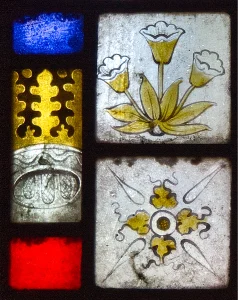
The 1890 Phare window in the north aisle is of the Resurrection and is dedicated to John and Mary Phare. The inscription reads I am the resurrection and the life and beneath are some smaller panes decorated with flowers.